
Weekly Briefing 🇺🇸

Pass “Protect and Serve Act”
Patrick Yoes, National President of the Fraternal Order of Police, warned that ten officers were shot—three of them killed—in ambush-style attacks over six days, part of a year-to-date toll of 196 officers shot and 26 killed, and called on Congress to finally pass the long-stalled “Protect and Serve Act,” which would establish a new federal crime for willful attacks on law-enforcement; though the House overwhelmingly approved the measure in 2018, its Senate version (S. 167) and House companion (H.R. 1551) remain bottled up in the Judiciary Committees despite broad bipartisan cosponsorship, and Yoes stressed that with 61 ambush attacks last year alone—and 12 killed so far in 2025—officers deserve the full weight of federal protection. 🏛️ More here
Powerful Eulogy for Fallen Officer
ICE Recruitment Provokes Anger
ICE recently sent recruitment emails to deputies in its 287(g) partner agencies—touting up to $50,000 signing bonuses, student‐loan repayment, and drawing on their frontline experience—which prompted backlash from sheriffs in Florida and beyond who felt “used” after helping enforce federal immigration laws. Polk County Sheriff Grady Judd and Pinellas County leadership publicly condemned the outreach as poor judgment that risks eroding trust, while the National Sheriffs’ Association warned DHS to mend fences. Some smaller departments say they simply can’t compete with federal pay and see deputies leave, though a few rural sheriffs defended ICE’s right to recruit. ICE has since apologized to at least one Georgia sheriff’s office, but many local leaders say stronger coordination is needed if the agencies are to remain true partners. 🔗 More here
Child-Abuse Network Dismantled
In Operation Grayskull—launched in 2020 and overseen at the highest levels of the FBI—the Justice Department shut down four heavily trafficked dark-web sites that together hosted millions of child-sex-abuse images and drew over 120,000 members. Eighteen alleged ringleaders—including William “Boss” Spearman, now serving life, and others like Selwyn Rosenstein and Matthew Garrell—have been convicted for operating and moderating these encrypted communities. Prosecutors described a sophisticated online ecosystem in which users “earned” access by paying fees, moderating forums, or uploading illicit content. FBI and DOJ officials hail the takedown as one of the most successful in history, noting that none of the shuttered sites have reappeared. ⚖️ More here
The Great Crime Paradox
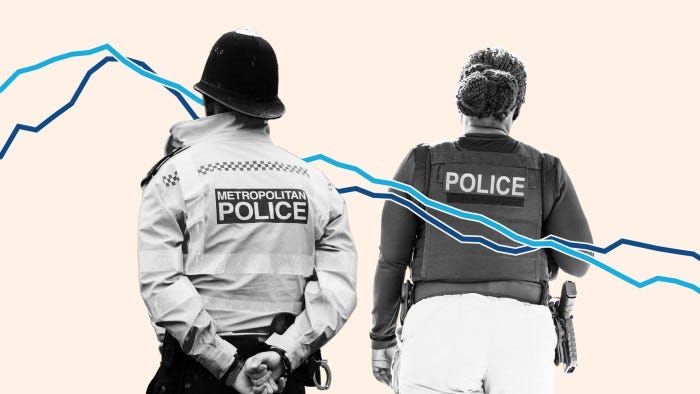
While violent crime in the US and UK has plunged to multi-decade lows—with homicides down more than 50% since the 1990s and UK violent offenses on a 30-year downward trend—public concern about crime is surging. John Burn-Murdoch writing in the Financial Times argues this “paradox” stems from the rise of highly visible low-level offenses (shoplifting, snatch theft, fare evasion, dog attacks and antisocial behavior), which occur in public, affect strangers, and signal a loss of order. At the same time, shrinking arrest and prosecution rates fuel a sense of impunity. The result: safer streets statistically, but a public that feels less secure—and calls for renewed focus on disorder as well as serious crime. More here
Gun Violence Exposure 📈 Suicide Risk
A recent study published in Social Science & Medicine surveyed 8,009 U.S. adults in 2024 and found that both frequent and recent exposure to gun violence—from knowing someone shot or threatened with a firearm to hearing gunshots in one’s neighborhood—significantly elevates risks of depression, suicidal ideation, and suicide attempts, and drives greater utilization of mental health services. Using validated measures (PHQ-9 for depression; SITBI-SR for suicidal thoughts), the researchers showed that even indirect encounters with gun violence carry enduring psychological harm. The authors call for targeted public-health interventions and increased support for communities—and the officers who serve them—that face repeated gun-related trauma. 📖 Study here
Funding Surges for Public-Safety Tech
Venture capital poured nearly $1 billion into U.S. public-safety and law-enforcement startups through early July—almost double 2024’s total—as investors embrace AI tools that can streamline 911 dispatch, analyze crime data and automate nonemergency call handling. Heavyweights like Sequoia and Andreessen Horowitz have backed voice-AI 911 assistants, analytics platforms that help detectives connect the dots in cold cases, and software to organize insights and manage agency responses. Founders say advances in AI, which lower development costs and accelerate procurement, have softened the once-daunting government sales cycle, opening new growth fueled by predictable public-sector revenue. 🤖 More here
ChatGPT Convos Aren’t Privileged
OpenAI CEO Sam Altman has confirmed that chats with ChatGPT lack attorney–client (or doctor–patient) privilege, meaning any legal questions you input—including details of potential crimes—could be subpoenaed and used against you in court. Unlike a licensed attorney who is bound by confidentiality and ethical duties, ChatGPT is merely a predictive language model with no obligation to protect your disclosures. Lawyers have warned for over a year that using ChatGPT for legal strategy generates discoverable evidence rather than privileged advice, so anyone seeking guidance on sensitive matters should consult a qualified professional instead. 💬 More here
Monkey (Crime) Business
At Uluwatu Temple in Bali, a troupe of long-tailed macaques has turned sightseeing into a cheeky crime caper—liberating sunglasses, smartphones and wallets from unsuspecting tourists, then bartering them back to their human handlers with ripe mangos, bananas or even coveted eggs. Researchers marvel that these furry bandits know which items score top trade value, showcasing primate entrepreneurship at its finest. Despite temple “pawang” tweaking feeding schedules and menus, the heist — and the playful pandemonium it creates — continues unabated, proving these mischievous macaques have truly cracked the code on economic monkey business. 🙈 More here
📺 Briefing Room, Ep. 02: Sheriff John Allen
In this episode of The Briefing Room, Sheriff John Allen of Bernalillo County, New Mexico, joins me for a wide-ranging conversation on rising officer-involved shootings in rural communities, the practical limitations of enforcing immigration policies, and the critical role of technology and training in policing. He also speaks openly about rebuilding trust with immigrant communities, combating human trafficking, and why “common sense” leadership matters now more than ever.
Autonomous Trucks Hit the Night Shift
Aurora Innovation has begun running its lidar-equipped, human-supervised semi-trucks between Dallas and Houston overnight, claiming its system can spot obstacles in the dark over three football fields away—about 11 seconds sooner than a human—before taking action. While Kodiak Robotics already operates unattended rigs on leased West Texas and New Mexico roads, Aurora keeps a safety driver onboard for now and is expanding tests to routes like Phoenix–Fort Worth. Proponents say driverless haulers could ease long-haul fatigue and free up local drivers for regional work, but skeptics warn of challenges in storms, winter weather and complex traffic. Aurora plans to tackle rain-soaked conditions before year’s end. 🚛 More here
Unmanned Police Helicopter Tested
The UK National Police Air Service has trialled the Schiebel Camcopter S-100—its first unmanned helicopter in the UK—which carries the same high-powered infrared camera as crewed aircraft but can stay aloft for eight to 12 hours, cut emissions by 90%, and operate more quietly. Funded by the Home Office and overseen by the CAA and NATS, night-time flights over the Bristol Channel demonstrated its value for long-duration searches for missing people and low-speed surveillance, while still retaining traditional helicopters for high-speed pursuits. 🚁 More here
Stigma Still Powerful Blocker
A recent survey of over 100 U.S. police officers shows that, despite widespread investment in wellness programs—from peer-support teams to on-site counselors—stigma remains a powerful barrier to care: 60 percent of officers said most peers wouldn’t disclose a mental-health issue to a colleague, nearly 75 percent believed they wouldn’t tell a supervisor, and more than half feared workplace discrimination if they sought help. Although roughly 90 percent were aware of department wellness resources, fewer than one in three had actually used them, and only two-thirds of those found them helpful. Given research indicating officers may endure about three traumatic events every six months (roughly 180 over a 30-year career), this reluctance heightens risks for PTSD, depression, substance misuse, and suicide. 💙 More here
—> For daily updates, go to Police Briefing