
The Weekly Briefing 🇺🇸

Gunman Targets CDC in Deadly Shooting
The New York Times reports that a 30-year-old Georgia man, fixated on conspiracy theories about COVID-19 vaccines, opened fire on the CDC’s Atlanta headquarters on Friday, killing rookie DeKalb County Police Officer David Rose before dying from a gunshot wound. Investigators say Patrick Joseph White, armed with multiple long guns, had recently sought mental health help but made no direct threats to the agency. The attack damaged several CDC buildings and prompted a temporary nationwide closure of CDC offices. Officials and public health leaders called the shooting a tragic example of how misinformation and hostility toward public health institutions can escalate into violence. 💙 More here
Clearance Rates Drive Cooperation
A new American Journal of Criminal Justice study by Kathryn Bocanegra and Aaron Gottlieb finds that both actual and perceived homicide clearance rates strongly influence whether residents will help police solve murders. Surveying 544 residents across five high-homicide Chicago neighborhoods, the researchers found that each 1% increase in the actual clearance rate boosted the likelihood of witnesses calling police or sharing suspect information, and those who believed more than half of murders were solved were nearly three times more likely to cooperate than those who thought clearance was under 10%. The findings highlight a reinforcing cycle: higher clearance rates build trust, which increases cooperation, which in turn helps clear more cases. 📖 Study here
President Orders Federal Police Surge
President Donald Trump has ordered a week-long surge of federal law enforcement in Washington, D.C., to “make D.C. safe again,” citing persistent violent crime and failures of local leadership, the Associated Press reports. The deployment includes U.S. Park Police, DEA, ATF, Marshals Service, and Capitol Police, supplementing the Metropolitan Police Department. The order follows the attempted carjacking of a senior federal official and comes as Trump renews calls to consider ending the city’s Home Rule authority. While D.C. officials note some recent crime declines, the president argues that federal action is needed to restore safety in the nation’s capital. 🚔 More here
NYPD Expands Quality-of-Life Teams
The New York Post reports that the NYPD’s “Q-Teams,” special units focused solely on quality-of-life issues, are expanding to cover all of Brooklyn after a successful pilot in six precincts. Since April, the teams have handled more than 23,400 calls on illegal mopeds, homeless encampments, open drug use, abandoned vehicles, and noise complaints, while towing 640 derelict vehicles and seizing 299 illegal e-bikes and scooters. Mayor Eric Adams and Commissioner Jessica Tisch credit the program with faster non-emergency response times and addressing public concerns about disorder, with full citywide coverage expected by mid-August. 🍎 More here
Loosening Education to Recruit More Cops
USA TODAY reports that departments in Dallas, Chicago, Memphis, Louisville, and New Orleans are lowering college credit requirements for new police recruits to address ongoing staffing shortages. Supporters say the change removes unnecessary barriers that keep otherwise capable candidates—especially those with military service or relevant life experience—out of the profession. While studies in Criminal Justice and Behavior have linked higher education to lower use-of-force rates and fewer complaints, experts note experience and good training can produce similar results. Police leaders argue that with today’s recruiting challenges, the priority is finding disciplined, service-minded officers who can meet rigorous academy and field standards, regardless of formal education level. 🎓 More here
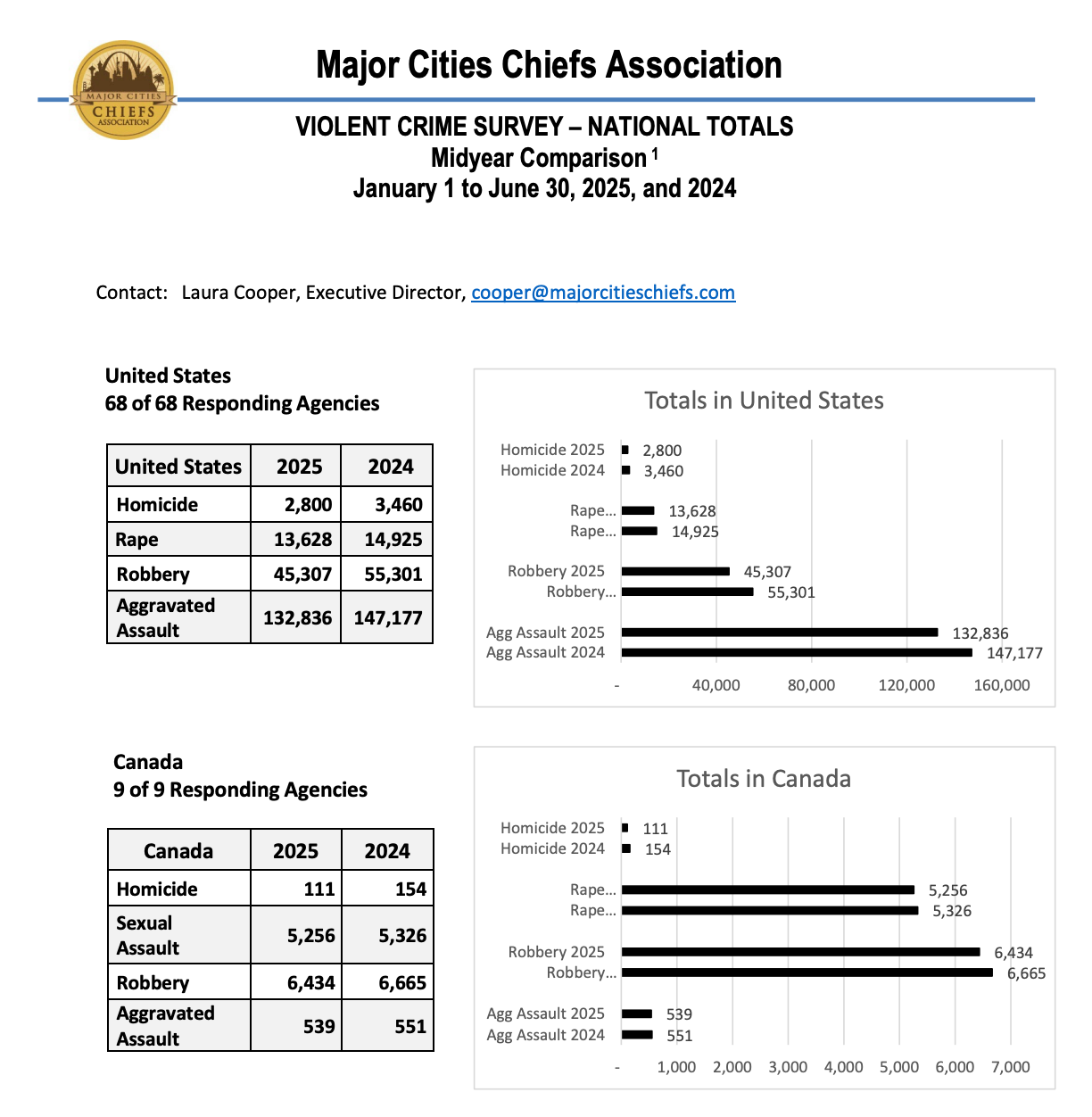
Full MCCA report, including breakdown by major city here.
DOJ Targets 35 Sanctuary Jurisdictions
The CBS News reports that the Justice Department has named 35 “sanctuary” states, counties, and cities — including California, New York, Illinois, and the District of Columbia — and vowed to sue jurisdictions that block cooperation with federal immigration enforcement. Attorney General Pam Bondi said such policies “put American citizens at risk by design” and pledged to work with DHS to eliminate them. The move follows President Trump’s April executive order requiring DOJ to publish the list and pursue legal action against defiant jurisdictions, part of a broader crackdown that has already led to lawsuits against New York City and other local governments. 🔗 More here
Medal of Valor Nominations Open
The U.S. Department of Justice’s Bureau of Justice Assistance is now accepting nominations for the 2024–2025 Public Safety Officer Medal of Valor, one of the nation’s highest awards for heroism by a public safety officer. Created by Congress in 2001, the medal honors law enforcement officers — including corrections, court, and civil defense personnel — as well as firefighters and emergency services officers who perform acts of exceptional courage, decisiveness, and swiftness of action to save or protect human life, regardless of personal safety. Nominations, which must come from the chief executive of the nominee’s agency, are open until October 3, 2025. 🎖️ More here
Marijuana Reclassification Considered
The Wall Street Journal reports that President Trump is weighing whether to reclassify marijuana as a Schedule III drug, a change that would loosen federal restrictions, allow cannabis businesses to claim tax deductions, and expand opportunities for medical research. The move, similar to a Biden-era proposal that was never finalized, has support from industry leaders who have contributed to Trump’s political groups and met with him directly. Supporters frame it as a popular, bipartisan issue, while opponents, including anti-drug coalitions, warn it could harm public health and youth. No final decision has been made. 😶🌫️ More here
Noise Cameras Give Police New Tool
The Wall Street Journal reports that cities from New York to Hawaii are adopting noise cameras—advanced systems using microphone arrays and license plate readers—to crack down on illegally loud vehicles, a frequent source of public complaints. Police leaders say the technology helps them enforce laws that are otherwise difficult to apply, especially when offenders speed off before an officer can stop them. Supporters note that early deployments in places like Newport, R.I., have already reduced repeat violations, freeing up officers for other calls while sending a clear message that chronic noise and nuisance driving won’t be tolerated. 📢 More here
🚔 More police news @ Police Briefing
🎧 Boldly Go Podcast, here