
The Weekly Briefing 🇺🇸

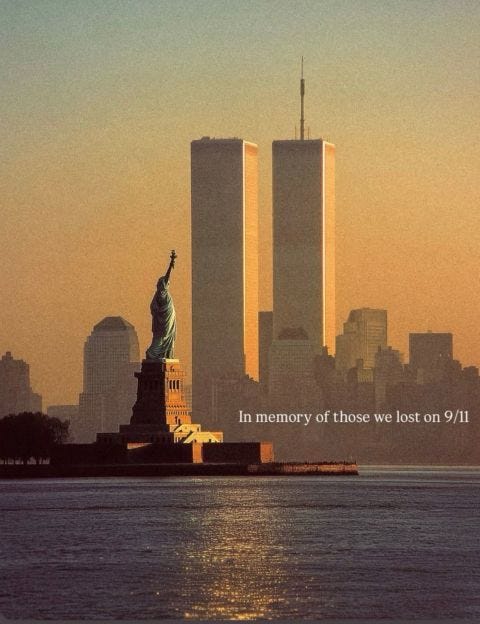
9/11 Death Toll Continues to Rise
On the 24th anniversary of the Sept. 11, 2001, terrorist attacks, New Yorkers gathered at the World Trade Center memorial plaza to honor the nearly 3,000 lives lost. The ceremony included the traditional reading of victims’ names, pauses to mark the moments when planes struck and the towers fell, and tributes by survivors and family members. The New York Times reports that the toll from 9/11 continues to grow, with more than 24,000 responders developing cancer and over 8,000 deaths linked to illnesses from toxic exposure at Ground Zero.🗽 More here
Photo and Tip Led to Arrest
The suspect in the killing of activist Charlie Kirk was arrested after a critical tip from his family, spurred by the public release of surveillance images. Authorities said Tyler Robinson, 22, of Utah, was identified when a relative, recognizing him in widely distributed photos, confided to a friend that Robinson had confessed or implied involvement. According to the New York Times, The friend alerted the Washington County Sheriff’s Office, which quickly moved on the lead. Robinson surrendered peacefully in St. George late Thursday, 33 hours after the attack at Utah Valley University. Federal and local agencies had mobilized significant resources, but the decisive break came when the images were released and Robinson’s family stepped forward. 🚨 More here
Political Violence on the Rise
The assassination of Charlie Kirk highlights a troubling escalation of political violence in the U.S., reports PolitiFact. In 2025 alone, attacks have included the fatal shootings of Minnesota Rep. Melissa Hortman and her husband, an arson targeting Pennsylvania Gov. Josh Shapiro’s residence, an ICE officer shot in Texas, and a gunman opening fire at CDC headquarters. Princeton’s Bridging Divides Initiative documented a 74% jump in threats and harassment of local officials since 2022, with more than 600 incidents recorded last year. Experts compare today’s climate to the 1960s–70s, when leaders from JFK to Martin Luther King Jr. were assassinated, but warn that unlike then, violent rhetoric has now gone mainstream. Polarization, social media amplification, and the widespread availability of firearms all heighten the risk. 🔗 More here
Preparing for Threat
In the wake of the killing of activist Charlie Kirk, former U.S. Capitol Police Chief Thomas Manger told WTOP News that elected officials and public figures should undergo formal security assessments and be prepared for the rising threat of political violence. Manger emphasized that securing venues is resource-intensive and requires careful sweeps before events, while also noting that tougher gun laws alone are unlikely to stop attacks when mental health issues are involved. He pointed to a surge in swatting incidents, often originating overseas, and warned of the radicalization of extremists across the political spectrum. Manger urged parents to pay close attention to behavioral changes in their children, highlighting the role of online content in fostering extremism, and said the nation must collectively reject political violence as a solution. 🔗 More here
High School Shooter Radicalized
The Jefferson County Sheriff’s Office identified 16-year-old Desmond Holly as the shooter who critically wounded two students before taking his own life at Evergreen High School on Sept. 10. Investigators, according to the Denver Post, said Holly had been “radicalized through an extremist network,” and his social media accounts contained antisemitic posts, Holocaust denial, and references to mass shooters including Columbine. During the attack, Holly roamed the halls with a revolver, repeatedly firing and reloading as students ran for cover, before turning the gun on himself. Authorities confirmed he brought significant ammunition, shot both inside the school and behind it as one victim fled, and left widespread damage to windows and lockers. 🔗 More here
This community grows through you. If today’s edition sparked an insight, pass it along to a colleague, teammate, or friend in public safety — that’s how we keep building together.
Idolized Mass Shooters
A 13-year-old boy in Pierce County, Washington, was arrested after deputies found 23 guns and ammunition in his home, along with social media posts idolizing mass shooters, according to the Associated Press. Investigators said the boy had written threats online, displayed weapons, and referenced past school shootings. A SWAT team raided the home and discovered tactical rifles mounted on walls, handguns left unsecured, and AR-style magazines inscribed with references to Columbine. The teen faces five charges, four of them felonies, including unlawful firearm possession and making threats. Authorities are also investigating whether his parents will face charges for unsafe gun storage. 🔗 More here
“Crime isn’t about numbers; it’s about people and the rule of law. Until we put politics aside, we’re not going to fix the problem.” — FOP President Patrick Yoes.
📺 Watch the full interview above
👍 Like & subscribe to support The Briefing Room
🔥 This week’s guest: Sacramento Police Chief Kathy Lester
Are Troops Allowed to Act as Police?
As National Guard troops patrol Washington, D.C. and President Trump threatens to send them to cities like Chicago, legal experts caution that their authority depends on who deploys them. Under state governors, Guard units can perform law enforcement duties, as in Minnesota during the 2020 riots. But if activated by the president, they assume a status similar to the U.S. military and are barred from policing under the Posse Comitatus Act of 1878. Exceptions exist, such as Eisenhower’s 1957 deployment to enforce desegregation in Arkansas. Legal scholars warn that attempts to use federalized Guard troops for routine policing would trigger litigation, as seen in California when Gov. Gavin Newsom sued over Trump’s deployment in Los Angeles earlier this year. 📖 More here
President Sending Guard to Memphis
President Donald Trump announced in a Fox News interview that he plans to deploy National Guard troops to Memphis, calling the city “deeply troubled” and pledging to “fix that, just like we did Washington.” The move follows weeks of threats to send the Guard to Chicago and comes despite Memphis recently reporting crime at a 25-year low, including the fewest murders in six years. Local leaders were divided: Shelby County District Attorney Steve Mulroy warned that short-term military deployments risk being “performative,” while Tennessee Gov. Bill Lee already holds authority to mobilize the Guard himself. Trump also signaled interest in sending federal authorities to New Orleans, while the White House framed the Memphis plan as part of a broader push to combat violent crime in cities led by Democrats. 🪖 More here
Broad Coalition Pushes NG911
A wide coalition of public safety organizations submitted a letter to Congress on September 9 urging action on Next Generation 911 (NG911). The group — which includes law enforcement, fire, EMS, and local government associations — stressed that NG911 will allow call centers to receive text, video, and real-time data, improving emergency response and officer safety. The coalition called for dedicated federal funding to ensure agencies nationwide can make the transition, framing NG911 as a vital public safety upgrade. ☎️ Letter here
FCC Moves to Jam Prison Phones
The Federal Communications Commission announced plans to vote Sept. 30 on allowing state and federal prisons to jam contraband cellphone signals, long a demand from corrections officials. Smuggled phones have enabled inmates to orchestrate riots, violent crimes, and even attacks on officers, such as the 2010 shooting of South Carolina prison officer Robert Johnson. According to the Associated Press, FCC Chairman Brendan Carr said the measure would close a loophole that leaves the public exposed, though the wireless industry has raised concerns about interference with legitimate communications 📲 More here
🚔 Daily police news @ Police Briefing