
The Weekly Briefing 🦃

764 Extremist Group
Federal authorities are escalating their response to the rapidly growing online network known as “764,” an extremist group that targets minors through grooming, blackmail, and coerced self-harm, according to reporting from ABC7 Chicago. The FBI now considers 764 a top-tier national security priority, with more than 350 open investigations tied to the network — up from 250 earlier this year. At least 28 defendants have been federally charged, including one case where prosecutors filed material-support-to-terrorism charges. The National Center for Missing & Exploited Children reports it is on pace to receive nearly 2,000 tips this year linked to 764-style exploitation. The network operates on mainstream platforms, often starting with gaming or social apps before moving victims into private channels. Law enforcement and child-safety advocates say 764 represents a new, decentralized form of online extremism — one that crosses borders, scales quickly, and requires parents, platforms, and police to coordinate more aggressively than ever before. 💻 More here
Treating Violent Crime Trauma
A new trauma recovery center in Grand Rapids is offering free psychiatric care, therapy, and case management for adults impacted by violent crime. The model — funded through a $1.6 million state grant — brings together psychiatrists, psychologists, social workers, and addiction specialists to provide rapid access to mental-health support, something hospitals say is often missing after the initial ER visit. While MLive reports this is the first center of its kind in West Michigan, it reflects a growing national movement toward trauma-recovery programs that treat violence as both a criminal and public-health issue. With violent-crime survivors across the country facing long waits for behavioral-health services, Corewell Health’s approach offers a template other cities are now exploring: integrated, no-cost treatment designed to break the cycle of trauma before it worsens. 🩺 More here
Violent Crime Spree Suspect Killed
Oklahoma City police say the man fatally shot by officers Saturday was responsible for a rapid and deadly crime spree stretching across multiple jurisdictions. Investigators identified the suspect as 34-year-old Deante James Hawthorne, a repeat offender with prior convictions for armed robbery and assault with a deadly weapon. According to law enforcement, Hawthorne began the day in Moore by shooting two people — killing one — before carjacking a vehicle and fleeing the area. Over the next several hours, he allegedly carried out another carjacking, committed additional shootings, and was linked to a second homicide in Oklahoma City. Officers eventually located him and attempted a traffic stop, which led to a pursuit and crash. Police say Hawthorne then tried to carjack yet another victim before officers opened fire when he ignored commands and posed an immediate threat. He was pronounced dead at the scene. 🔗 More here
Deputy Shot and Killed
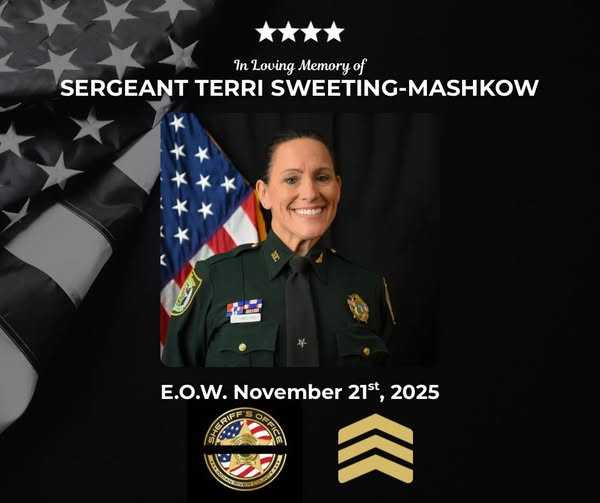
Indian River County (FL) Deputy Terri Sweeting-Mashkow was shot and killed Friday while assisting a mother with an eviction order for her son. Deputies and a locksmith were on scene when the son, Michael Halberstam, opened fire, striking Deputy Sweeting-Mashkow and two others. The sheriff’s office said they had responded to the residence seven times this month. Halberstam died the next day from his injuries. Sweeting-Mashkow had served 25 years and was posthumously promoted to Sergeant. Officials said this is the agency’s second line-of-duty death in 100 years. 🖤 More here
Turning to AI to Fix Roads Faster
As America’s aging streets fall behind on basic upkeep, cities and states are deploying new AI tools to spot hazards and prioritize repairs, the Associated Press reports. Hawaii is giving away 1,000 AI-enabled dashcams that automatically detect damaged guardrails, faded lane markings, and road debris — a push that comes amid a spike in traffic deaths and after a $3.9 million settlement tied to an unrepaired guardrail. San Jose found that AI cameras mounted on street sweepers correctly identified potholes 97% of the time, and Texas is using both camera data and cellphone-based analytics to locate unsafe signs, obstructed stop controls, and risky driver behavior. Experts say these early efforts are laying the groundwork for a future where most vehicles — human-driven or autonomous — continuously feed road-condition data back to transportation agencies. 🚙 More here
New Report on Traffic Safety
A new PERF report makes clear that something went very wrong on American roads during COVID. While Europe saw traffic deaths fall during lockdowns, the U.S. went the opposite direction — recording nearly 7,000 more fatalities in 2021 than in 2019, a 24.3% jump per 100 million miles traveled. PERF traces the spike to reduced traffic enforcement during the early pandemic, public unrest after George Floyd’s murder, and nationwide staffing shortages that limited proactive policing. At the same time, speeding, distraction, and drug- and alcohol-impaired driving all increased. The report includes 10 recommendations, emphasizing data-driven traffic enforcement, preparing officers for emerging technologies like automated enforcement and autonomous vehicles, and reinforcing that traffic safety remains a core policing responsibility. The central finding: when enforcement drops, crashes rise — and agencies must rebuild traffic strategies that save lives while maintaining community trust. 📈 Report here
The Future Is Safer Than Expected
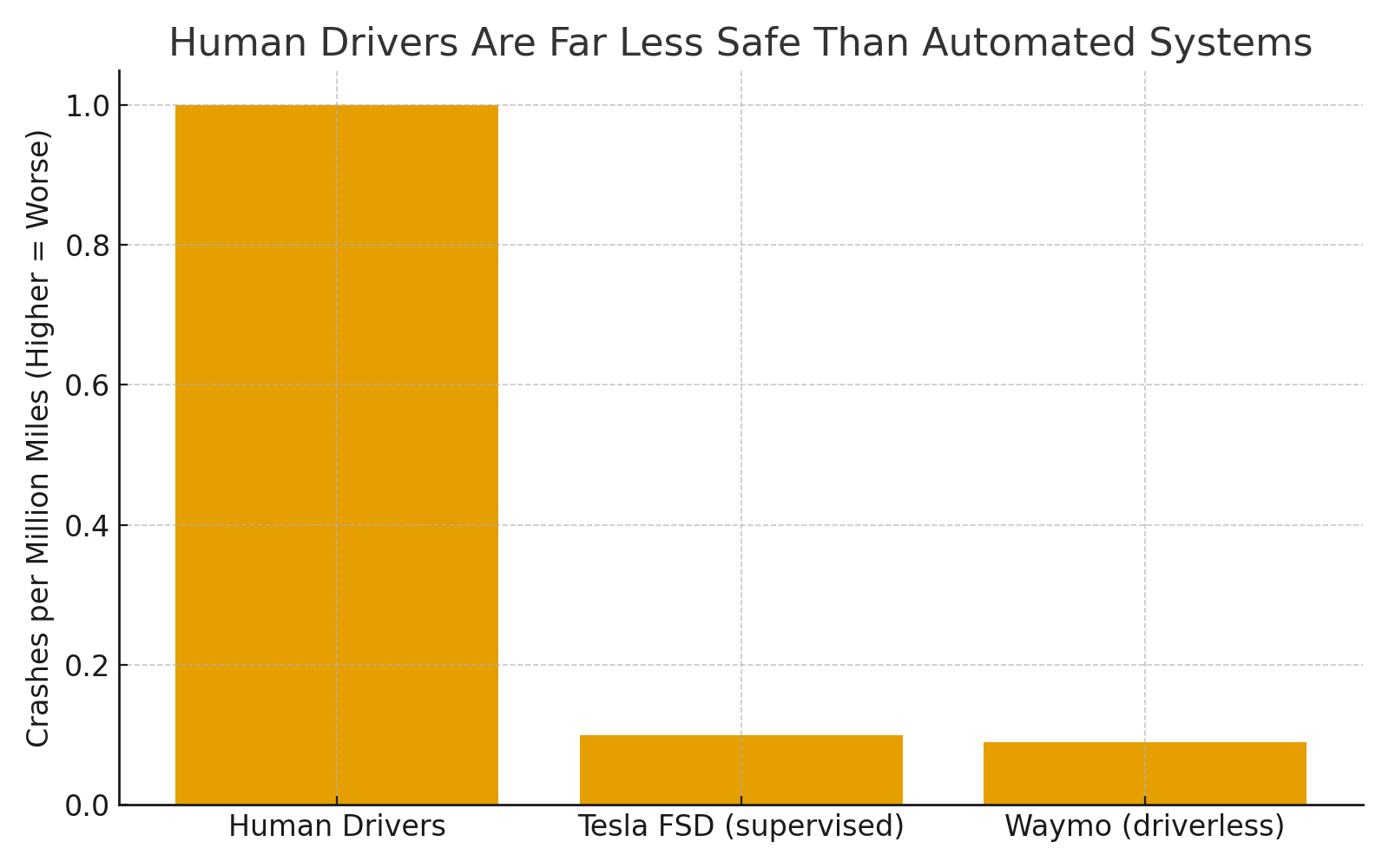
The data coming out of the autonomous driving world is becoming impossible to ignore: when you remove—or even just minimize—the human in the loop (the driver), the roads get a whole lot safer. According to a Weekly Briefing analysis, Waymo has now logged more than 96 million rider-only miles, and independent researchers found its vehicles experience roughly 80% fewer injury-causing crashes than human drivers. Meanwhile, Tesla reports its Full Self-Driving (Supervised) system goes 2.9 million miles between major collisions—almost 6× safer than the U.S. human-driver average of 500,000 miles between crashes. Here’s the striking part from the chart below: humans aren’t just slightly worse—they’re an order of magnitude worse. Against both Waymo and Tesla, human drivers generate far more collisions per mile, reinforcing a simple truth: the machines are already outperforming us at the one task we’ve spent a century insisting only humans can do.
Officer Killed in Pursuit Crash
ABC7 reports that Alhambra (CA) Police Officer Alec Sanders, 28, was killed early Wednesday after a police chase ended in a collision at Valley Boulevard and Edgewood Drive. According to the California Highway Patrol, the driver of a stolen Hyundai SUV, identified as 27-year-old Steven Zapata, collided with Sanders’ patrol vehicle during the pursuit. A 33-year-old passenger in the suspect vehicle died at the scene, and a second passenger was hospitalized. Zapata was treated for injuries and arrested on suspicion of second-degree murder. Sanders had been with the department for eight months and is survived by his fiancée and siblings. His death is the seventh line-of-duty loss in Los Angeles County this year. 🖤 More here
Consent Decree Ended in NOLA
A federal judge has formally ended the long-running consent decree governing the New Orleans Police Department (NOPD), concluding one of the most expansive police-reform efforts in the country, according to The Times-Picayune / The New Orleans Advocate. The order ends 12 years of federal court oversight, which cost the city roughly $20 million in monitoring and required sweeping reforms across training, use of force, supervision, internal investigations, and community engagement.
State Police Recruiting Women
New Mexico is trying something most agencies talk about but rarely execute: a statewide, sustained effort to grow the number of women in policing. According to The Santa Fe New Mexican, women currently make up just 9% of New Mexico State Police — below the national average of 12%. The governor’s office and NMSP leadership have launched a series of recruitment initiatives aimed directly at female candidates, including statewide “Her Call to Serve” seminars, mentorship programs, targeted outreach on college campuses, and a traveling citizen academy designed to introduce women to law-enforcement career paths. Four women are in the current academy class, which would bring the agency to nearly 10% representation if they graduate. State leaders say the goal is to reach 12–15% within two years. 🔗 More here

K9 Spike Shot and Killed
A Burbank (CA) Police Department K9 was shot and killed during a search for a fleeing suspect Saturday evening, according to KTLA. Officers had stopped a vehicle when a passenger ran into a nearby neighborhood, prompting a large response with a police airship and K9 Spike. Spike located the suspect in dense brush and was shot by the armed man, later dying at an emergency veterinary hospital. The suspect was later found still armed and refused to surrender despite repeated attempts by Burbank and Glendale officers and SWAT. He fired on police, striking units before officers returned fire and killed him. A handgun was recovered. 💔 🐕 More here
🚔 Daily police news @ Police Briefing
The AV safety data is pretty striking when you see it laid out like that. The 6x difference between Tesla FSD and human drivers is one thing, but Waymo being 80% safer on injury crashes makes you wonder how long it'll take before people really accept that machines are actualy better at this. I think the biggest hurdle now is just psychological becuse we're so used to being in control. That PERF traffic safety report ties into this too, showing how enforcement matters for changing behavior, but eventually we might not need as much of that if the cars themselfs are doing most of the work.
Statistically speaking, there are very few areas in policing where we can demonstrate a fairly direct causal impact on outcomes. Most of what we do is correlational.
Traffic enforcement is one of the rare exceptions. When officers consistently enforce speed, impairment, and seatbelt laws, and actually issue citations, not just warnings; crashes and fatalities go down. The COVID period is a case in point: enforcement dropped, risky driving went up, and fatal crashes spiked even as traffic volumes fell. It was not uncommon to get passed by cars going 100mph + on the interstate, and some of those cars I wouldn’t want to go 55 in, let alone double that!
Writing tickets is one of the least favorite tasks for most cops, but it’s also one of the few things we do where the data show a real effect on saving lives.